
Staying onsite vs. offsite at the Tokyo Disney Resort
For those who use Walt Disney World (WDW) as their frame of reference, staying "onsite" can have major implications for their Disney trip. At over 27,000 acres (109 sqkm), WDW is an enormous area of land and so by definition, anything "off property" is going to be a relatively significant distance to the parks. There are plenty of reasons to stay offsite - whether price, accommodation size, or proximity to non-Disney sites - but there is no denying that most of the Disney properties offer a sizeable advantage in terms of location. The sheer scope of Disney properties is also staggering, with over 30 properties offering a myriad of different room types to suit all tastes and budgets.
For Disneyland Resort (DLR) fans, the situation is quite different. A lack of Disney "bubble" means that there are actually non-Disney properties that are closer to the park gates than the three official "on site" hotels. While there are good reasons to stay at those branded properties, there is far less inherent value in the "onsite vs offsite" debate, and each hotel can simply be evaluated on its merits.
Early entry to the parks is also a major factor when choosing to stay onsite at WDW whereas this perk was recently removed at DLR.
The official hotels at Tokyo Disney Resort fit somewhere in between what we have at WDW and DLR. Let's look at the numbers:
Walt Disney World | Disneyland Resort | Tokyo Disney Resort | |
|---|---|---|---|
Number of hotels | 31 | 3 | 7 |
Number of rooms | 23,000 | 2,400 | 3,500 |
Early entry | Yes | No | Yes |
A couple of additional points to put these numbers in context. First, and most obviously, DLR and TDR only have two parks compared to the four (plus two water parks) at WDW. Second, due to the sprawling amenities at WDW, guests tend to stay for longer and on a given day you are more likely to find hotel guests who are not at the parks. At both DLR and TDR, guests are generally going to only stay for a couple of days, and will most likely be in the parks during those days. Thus, while there are certainly less hotel guests at the parks in TDR than WDW, the magnitude of difference is less than it might first look on paper. Indeed, the ability to use "Happy Entry" (TDR terminology for early entry) is probably more impactful on your day than Early Entry at WDW despite the fact that this table makes it look like not many guests are using that privilege.
On Site Hotels at Tokyo Disney Resort
Disney lists seven on site hotels, but this is really six as one - the Grand Chateau at Fantasy Springs is more of a special wing at another hotel than its own location entirely. Here's the onsite hotels in a nutshell, in OLC's own (lightly edited) words:
Tokyo DisneySea Fantasy Springs Hotel: has its own entrance into Fantasy Springs, at the back of DisneySea. Lightly themed to several Disney princesses. Includes two buildings: the Grand Chateau (link), a "luxury" property, and the Fantasy Chateau (link), a "deluxe" property"
Tokyo Disneyland Hotel (link): faces Tokyo Disneyland Park, with the Disney Resort Line Station Building located in between. The hotel is filled with fantasy, featuring a gorgeous Victorian-style atmosphere and an interior sprinkled with Disney motifs.
Disney Ambassador Hotel (link): themed to America in the 1930s, during the golden age of Hollywood. The hotel features elegant Art Deco designs, inside and out, and a sprinkling of unique Disney Character motifs to bring a smile to your face.
Tokyo DisneySea Hotel MiraCosta (link): located inside Tokyo DisneySea, with its own special entrance to the park. Guests can reminisce on their adventures at the Park, and look forward to the next day of excitement, in a luxurious setting with a classic Italian feel.
Toy Story Hotel (link): inspired by the Disney and Pixar Toy Story films, immersing guests in a world filled with the wonder of childhood dreams, imagination and play.
Tokyo Disney Celebration Hotel (link): Located in the Shin-Urayasu area, this hotel offers a casual resort stay with a simple service style. The hotel is comprised of two buildings, each featuring different themes. Tokyo Disney Celebration Hotel – Wish is themed to dreams and fantasy, and Tokyo Disney Celebration Hotel – Discover captures the excitement of adventure and discovery.
Off Site Hotels at Tokyo Disney Resort
TDR has three categories of affiliated hotels, but the only one that will be of interest to most overseas visitors is the somewhat confusingly named "Offical Hotels". The other two - Partner hotels and Good Neighbour Hotels - are scattered all over Tokyo and not particularly convenient for anyone focused on a park visit. If you are only spending a day or two at Disney as part of a longer Tokyo stay, they might be worth looking at as they sometimes include a shuttle to the parks.
There are six Official Hotels:
Hilton Tokyo Bay
Sheraton Grande Tokyo Bay
Tokyo Bay Maihama Hotel First Resort
Grand Nikko Tokyo Bay Maihama
Maihama View Hotel
Hotel Okura Tokyo Bay
I can't give detailed reviews of all these hotels having never stayed there, but can recommend the Sheraton Grande following our 5-night stay (detailed review to come soon). The location of all six hotels though is very convenient and in fact, let's get a lay of the land where all these "official" hotels are, along with the "on site" Disney properties:

Walking to the Parks
One important factor when selecting any hotel for a Disney trip is the proximity to the parks. In Tokyo, in large part that question is actually "proximity to the closest monorail station". Whichever hotel you select, you are going to find yourself on the monorail to get to at least one of the parks and the location on the map doesn't tell the whole story.
For Tokyo Disneyland, you can walk to the park if you are staying at the Tokyo Disneyland Hotel but everyone else is either riding the monorail (or I suppose catching a taxi as needed). For Tokyo DisneySea, staying at the Fantasy Springs Hotel or Hotel MiraCosta will allow you to walk to the park, but everyone else is on the monorail. Frustratingly - but understandably - there is a separate park entrance to DisneySea through the Fantasy Springs but this is (generally) only available as an entrance to guests of that hotel. We say "generally" because one nice little perk of staying at the Toy Story Hotel is that you can use the Fantasy Springs park entrance to exit the park at any time, or as an entrance after 10am. The latter perk isn't going to be too useful for most guests as for DisneySea you really need to be there at park opening, but the ability to exit through the back entrance is really nice. At the end of a day at DisneySea you can head in the opposite direction of most park guests towards the back of the park and then you simply cross the road and you are at your hotel, which saves quite a bit of time compared to waiting for a monorail (although the monorail is extremely efficient).
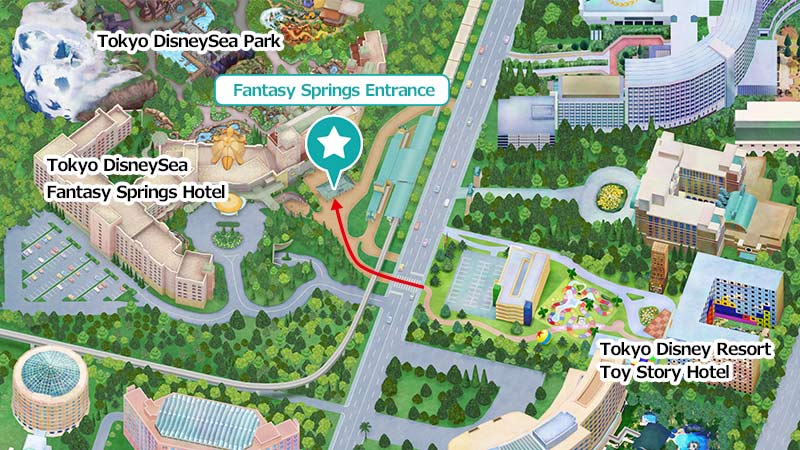
It's also worth noting here that while three hotels offer the ability to walk to the parks, each value proposition is slightly different.
At the Tokyo Disneyland hotel, guests can enter the park using the Happy Entry perk (more on this later) but still just enter through the main entrance along with guests from the other five Disney hotels).
For the MiraCosta Hotel, hotel guests are able to take advantage of a special entrance - only available to guests at this hotel - which takes you into Mediterranean Harbour where you quickly merge with all other guests. This either gives you a small, but potentially valuable head start over other hotel guests, or allows you to take your time a bit more in the morning, knowing that you don't need to get to the park entrance quite so early.
Guests at the Fantasy Springs Hotel, in my opinion, enjoy a fairly substantial advantage, and while that is sometimes reflected in the nightly rate, when booking vacation packages it isn't always too much more to stay at the Fantasy Springs hotel, so this perk might move the needle for you, even if you are otherwise unmoved by this hotel. Again, more on this shortly.
Riding the Monorail
TDR operates its own monorail (the "Disney Resort Line") which is fantastically efficient, clean, and often has trains themed to the latest event happening at the parks. You do have to pay a marginal cost (¥300 or under US $2 at the time of writing) but even for a family this isn't going to massively impact your budget. The bigger impact is wasted time and so I would strongly recommend purchasing a multi-day pass for the duration of your stay. Unless you literally don't leave your hotel, or take a lot of taxis, on most days you will use the monorail twice and not only come ahead in terms of price, but also in terms of time saved not having to queue up every time to purchase your ticket.
Ticket Type | Adult (Ages 12 and over) | Child (Ages 11 and under) |
|---|---|---|
1-Day Pass | ¥700 | ¥350 |
2-Day Pass | ¥900 | ¥450 |
3-Day Pass | ¥1,200 | ¥600 |
4-Day Pass | ¥1,500 | ¥750 |
At peak times, the monorail can run as often as every 3 minutes, slowing to around once every 10 mins in the slower periods of the day/year. A complete loop takes around 12 minutes and it's worth remembering that the trains only run anti-clockwise, so getting to DisneySea from the Toy Story Hotel (i.e. Bayside Station) will be a quick 4 minute hop, but coming home will be more like 9 minutes as you need to pass through the Resort Gateway and Tokyo Disneyland stations on your way back.

Happy (Early) Entry
This deserves its own post, but in a nutshell, Happy Entry is the TDR equivalent of WDW / DLR Early Entry program (now defunct at DLR), with a couple of wrinkles:
Hotel guests are only given a 15 minute head start on day guests, and the attractions don't open during that time, you are just allowed to enter the park and make your way to your first attraction. For example, if the park is set to open at 9am, Happy Entry guests get into the park at 8:45am but the rides themselves only come online at 9:00am.
Not all Disney hotel guests have the same level of Happy Entry access. Below is correct at the time of writing (June 2026) but is worth checking the official site as things can change:
Hotel | Disneyland Happy Entry | DisneySea Happy Entry |
Fantasy Springs |  | |
Hotel MiraCosta | | |
Tokyo Disneyland Hotel | | |
Ambassador Hotel | | |
Toy Story Hotel | |  |
Celebration Hotel | | |
Hotels will occasionally have blackout days from the Happy Entry program, though these don't tend to apply to the Tokyo Disneyland Hotel at Disneyland, or Fantasy Springs / MiraCosta at DisneySea. The Grand Chateau at Fantasy Springs is rarely (if ever) blacked out from either (as you would expect with the price you are paying!)
The 15 minute window doesn't sound like much but it can have a material impact on your day for a couple of reasons:
You can only start booking Premier Access (DPA) passes after you scan into the park, so by getting in at ~8:45am you can start booking earlier than many other guests. For something like the Happy Ride with Baymax that could mean an earlier return time, which then means you'd be eligible for your next attraction sooner. For something like Anna and Elsa's Frozen Journey it could literally mean the difference between getting a return time at all. It's hard to believe but during busy times, all of the day's initial batch of return times could sell out in that 15 minute window (they usually release some later in the day).
You can get a jump start on requesting (free) access to all the shows you are interested in for that day.
You can get in line for a priority attraction, which means can have a ripple effect throughout the day. An example if useful here. You are going to DisneySea and utilize Happy Entry. You snag a DPA for Frozen on your way to Journey to the Centre of the Earth. By riding that attraction quickly, you'll have a good shot and at still getting to, say, Tower of Terror or Toy Story Midway Mania before the crowds build there. You could then move onto smaller rides (who should still have low waits) or select a couple of others you are willing to wait for. Either way, you're looking at having 5 or 6 rides under your belt having only really queued for one of them. Mix in another DPA later in the day, and you're going to see a lot of DisneySea without too much pain. More detailed touring plans will be the subject of a separate post.
Staying at the Tokyo Resort when not going to the parks
One final note here is for anyone interested in staying for a longer time in Tokyo (not just the days you are in Disney). Firstly, I would highly recommend this. Tokyo is an incredible place - my own favourite city in the world - and is one of the best destinations in the world to travel to with kids. It's easy to get around, it's incredibly safe, accessible food is easy to find, and there are countless of things designed with kids and families in mind.
The question then is whether you should do a "split stay" with some time staying at the Disney Resort area and other days in the city proper. There are advantages both ways, but having recently stayed for a week at the Sheraton Grande where we did four days at Disney and three days in the city, here are some of the advantages (and disadvantages) we found:
Although the rooms at the official Disney hotel are small, some of the partner hotels offers some really good rooms that give you more space than you are likely to find if you stay in one of the popular areas in the city. Having the ability to spread out a bit and have somewhere to sit during the day is important to our family and the Sheraton Grande delivered perfectly.
Getting to the city takes a while and you are committing to 30-40+ minutes to get to pretty much anywhere of interest in the city. But, that is also possibly true if you stay in the city. Ueno Park to teamLab Planets is two trains and 40 minutes. The Tokyo SkyTree to Shibuya is 35 minutes. It's going to be 50-60 mins from anywhere to get to the Ghibli Museum. For reference, the below are approximate times (and number of train connections) from JR Maihama station (located adjacent to the Resort Gateway monorail station). Now, remember that you'll also need to spend 5-10 minutes getting to Maihama from your closest monorail stop, though I will say that with our kids, this never caused an issue: they were more bothered when on a single train for a long time (possibly having to stand in a busy car):
Tokyo station: 15 mins (direct)
teamLabs Planets: 25 mins (2 connections)
Ueno Park: 30 mins (1 connection)
teamLabs Borderless: 35 mins (1 connection)
Shibuya: 40 mins (1 connection)
Ghibli Museum: 1h20 (1 connection)
Being close to Ikspiari (TDR's version of Disney Springs / Downtown Disney) gives you good access to affordable and accessible food options. This can be useful not only if you have members of your party who aren't totally sold on Japanese cuisine - think McDonalds or the Rainforest Cafe - but also if you want a quick round of noodles or sushi without having to wait in a more formal setting. The grocery store - Seijo Ishii - has a solid selection of prepared meals that you can take back to your hotel (they also have microwaves to heat it up).
Getting to the airport is relatively straight forward thanks to the Airport Limousine Bus which offers service to/from both Narita and Haneda airports. If you are moving on to a new city though, hauling your luggage to the station is a bit painful and you'll want to make sure that you try and avoid rush hour and only have enough luggage that you can comfortable carry. That said, from JR Maihama station it's a quick, direct train to Tokyo Station so it's very doable, but obviously not as easy as if you were to stay near Tokyo Station or Shinagawa.


Comments